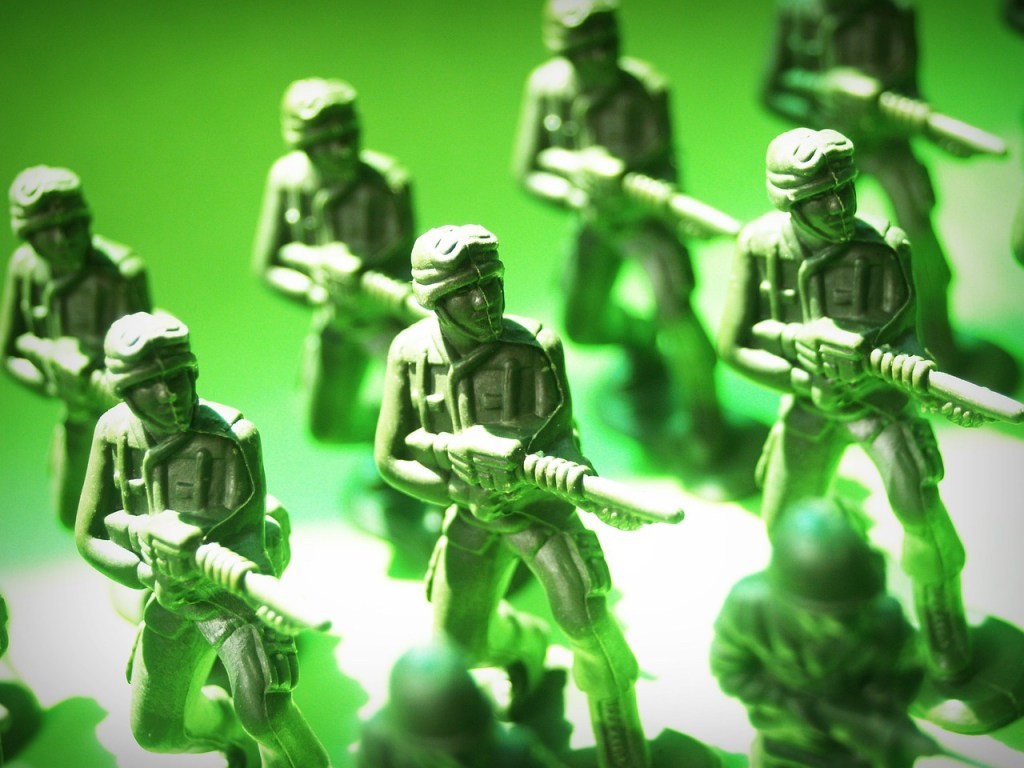
I took a solemn oath when I enlisted in the Army that I would defend the United States Constitution against enemies both foreign and domestic. During training, I was taught how to fight the enemy. Sadly, nobody took the time back then to prepare me for the battle brought into my life near the end of training and the war that rages inside my head still today.
We know that protecting the United States comes at a cost. Soldiers are willing to place their lives on the line every day for our country’s safety and freedom. We are told, and we believe, that the enemy is somewhere out there: in a foreign country, wearing a different uniform, on the other side of the line. We believe those on our side are like us: trustworthy, honorable, and good. We think we stand with them in solidarity. We rarely discuss the pervasive destruction of the enemy within…the domestic enemy. This is the American citizen who raises hell on our own soil and terrorizes others by destroying their right to life, liberty, and their pursuit of happiness.
The personal side of this internal struggle is also rarely discussed. No one joins the military expecting to be attacked by the soldier next door. Nobody expects to serve in the armed forces, knowing their enemy will stand in their unit’s formation every morning. We enlist, ill-prepared to fight a battle with a person who should be our comrade, should have our back, is a part of our team. Our domestic enemy.
It is no different in the civilian world. Stranger danger is a real cautionary message that needs to be taught to our children, to ensure that they are aware of their surroundings and do not blindly trust any random person who walks into their lives. But it is far more likely for a child to be hurt by someone they intimately know. The very people who should protect, love, and cherish us often become abusers, attackers, and haunt victims long after the horrors of sexual abuse and assault have ended. It appears we would prefer to turn a blind eye to the reality that stalks the vulnerable inside our own “united” country, military unit, or community. The reality is that we live in a fallen world where the people closest to us have the greatest access to do the most damage: physically, psychologically, and spiritually. And so, they are statistically more likely to do so.
I grew up in a small town, attending an even smaller church, in a Christian family. I lived a fairly blessed and sheltered life. I was naïve. I joined the Army at the age of 18, bright-eyed and motivated, full of potential and brimming with excitement. I wanted to learn a foreign language and travel the world…and I did. I was also brutally raped during my training by a man who claimed to be my friend. For years afterward, he continued in attempts to assault me, verbally abuse me, harass me, and stalk me. My life became a living nightmare and not because of some foreign enemy in some far-off distant land, but because someone drew close to me and because of that close proximity, had access to deeply hurt me.
For years, I stood very near my attacker in morning formations, I lived on the floor below his barracks room, and I shared a co-ed bathroom with him. I had prepared for hand-to-hand combat. I had prepared for tactical military movements. I had prepared to fire a weapon. But I had not prepared to face betrayal by a friend, to die inside and become a shell of a person for so long, nor was I prepared to face the reality that was left behind in the aftermath of trauma.
And so, my response to a toxic situation wasn’t the healthiest. I didn’t serve our country during a sanctioned time of war, and yet, I fought daily as best I knew how at the exact place I called home. The terrifying abuse piled up in my life and I coped by becoming borderline alcoholic and cycling through periods ruled by anorexic tendencies. Time and time again, I dumped the kind man I eventually married because I didn’t feel worthy of love. In my pain, I repeatedly wounded him and sabotaged our relationship. I didn’t know what a panic attack even was…and yet, I experienced them daily. I suffered through strange physical maladies all directly tied to this type of trauma. I struggled with clinical depression and debilitating anxiety. I raged, at no one and everyone, and especially at myself. I fought to the point of exhaustion against an invisible foe.
During my struggles, I walked away from God and eventually back again. For a time, I legalistically clung to religion like it was my lifeline, oblivious to the fact that faith is a relationship with someone who holds the power to strengthen me when I am weak, help me up when I stumble and fall, provide guidance when I am confused, and love me even when I am at my worst. My healing began by identifying my real enemy and, this was the biggest lesson I learned, it wasn’t God! As I stepped back and surveyed the damage in my life, I was able to gain perspective and see more clearly. The strategy I was given when dealing with issues in my life that hit close to home was quite simple and I have found it can be applied in most truly toxic situations: Distance yourself to limit access by way of proximity and implement healthier boundaries.
When someone or something is toxic and will not respect you, it’s necessary to draw back so you can get a better view of what is going on before dealing with the issue. Whether the person is a stranger or someone who knows you quite well, keeping your distance is a useful tool that also minimizes the damage they can do to your life. For your mental health and for your personal safety, you must protect yourself from those who do not have good intentions by creating space so you aren’t forced to engage in confusing, desperate, blind battles of self defense. This might look like a full retreat by cutting someone off forever. This might look like a trial separation. This might mean you silence notifications and snooze someone’s social media account for a time.
Another effective strategy I found helpful is to create a barrier of some sort. Boundaries communicate quite clearly where your limits lie and what you will do if the person violates your personal space with their drama. Boundaries are not about controlling or manipulating the other person’s behavior. I don’t expect the devil to change or the person who attacked me to change. Rather, boundaries are clear and concise declarations about what your response will be to certain behaviors. Knowing this, the other person is left to choose how they will behave and suffer the consequences or reap the benefits, depending upon their subsequent choices.
There are many other ways to deal with toxic situations and hurtful people, but these two strategies have been most helpful in my healing journey. However, I first had to acknowledge that I was far more likely to experience hurt from within my inner circle than to be kidnapped by some random stranger. Armed with this fact, I am no longer confused by the rare verbal attack I receive nowadays and I know how to better respond when I become aware that there is an issue present in my life. Am I perfect in how I implement these strategies in my life? No. But I am prepared…and that has made all the difference.
 Wisdom from the Trenches
Leave a comment