Many people say that they keep a diary to write down events that occur and how they feel about things. It’s rare to hear someone state that they keep a journal. Aren’t they one and the same – interchangeable terms? Well, not really… A diary is a book someone keeps to record events in one’s life as they happen. A journal has a broader definition, is a bit more intimate, and contains personal observations, feelings, and thoughts. In short, diaries are for recording; journals are for processing, which is immensely helpful when it comes to tackling trauma. Besides, if I had chosen to write about diaries, the title would have been a bit off-putting. “Diary-ing for Dummies” sounds like I’m writing a blog about bowel issues and looks like I didn’t make it to the state spelling bee in fifth grade. (Sidenote: I didn’t.)
Contrary to the title’s insinuation, journaling is not for dummies. In fact, it’s so incredibly easy that anyone can do it! Okay, I hear you. You’re not a writer. But here’s the thing: journaling isn’t about writing. Journaling is about processing. That’s right. Let me say that a different way: a journal is simply a compilation of notes or images directed that keep memories alive about times, spaces, thoughts, feelings, and revelations. With this definition in mind, the idea of what a journal is expands from a dust-covered book with pages that stare blankly into your soul to basically anything that keeps a running record of, well, not just you…but your innermost being. With the exception of the record being about you, your inner thoughts and feelings, and your memories (as opposed to, say, your tortoise’s), there are essentially no “rules” to journaling, which makes it incredibly easy to do. You are in control of how public or private the journal will be. You are in charge of the form that journal might take. You are the person who contributes to the journal, as often or as infrequently as you would like, and with the content you decide to record.
Perhaps you’ve been living under a rock for the past few years and you are blissfully unaware of the post-pandemic, mental health crisis facing our world today. In that case, you might not have heard of the physical health benefits of brain dumping trauma, anxiety, depression, or hurt onto paper, but the physiological benefits of journaling are quite extensive and entirely backed by scientific research. If you are curious about this claim, simply Google it and all the relevant scientific studies will pop up in the search results. Journaling helps people:
- Increase their emotional intelligence by promoting situational awareness and emotional connectedness with oneself and others
- Cut through the chaos and busyness in this life to get in touch with their innermost thoughts and feelings
- Reduce the stress of everyday life or facing traumatic events, lowering blood pressure and increasing immunity
- Successfully process difficult circumstances or events in life
- Think through the intricacies of a situation in order to best problem-solve
- Regulate emotions better, which opens pathways for a more peaceful existence
- Halt the brooding cycle, where obsessive thoughts hold the mind hostage for extended periods of time
- Lower anxiety, which significantly improves overall mood
- Acquire perspective that helps avoid the pitfall of catastrophic thinking in the future because there is a record of making it through particularly difficult times in the past
- Reminisce about good times, lessons learned, and bittersweet memories by providing a chronological record of those experiences and personal insight during that time
In case you are still reading and your status of not being a writer has not changed in the last two minutes, allow me to provide you with some encouraging news: All these benefits, and even some bonus benefits, can be YOURS for free, even if you haven’t woven words together to form cohesive paragraphs since your college English course fifteen years ago! Journals can take so many different forms and feature various avenues to self awareness, and not all contain specific word counts. Or words. At all.
In my case, I do identify as a writer and so, I keep a standard blank book with lined pages that I write actual words in on a regular basis. I start with this type of journal because it is the most widely known and, therefore, the easiest to explain. Imagine: Pages. Filled with words. That you wrote. About life. And about you. This is a standard journal. I refuse to give personal details, but I will give you a general overview of what I write about in my journal. Just kidding. I’m not going to do that. It’s private.
A gratitude journal is an easy-peasy way to record short snippets (or long-winded dissertations) about what brings you immense joy in life. I use a specific kind of daily planner that has a tiny space at the bottom of each day’s schedule for a quick record of something positive from that day. Anything positive. Folks, this one sentence has transformed my pretty day planner into a gratitude journal! At the end of the year, I go back through my planner where my schedule has been meticulously recorded and daily gratitude statements feature prominently throughout the year. I come to the same realization every year: While my time in this life always contains unavoidable ups and down, there is always something for which I can be grateful (big or small) and life is generally good.
Did you know that scrapbooking can be considered a journal? Listen, before you start discounting your artistic ability, I want you to consider something: scrapbooks can be handmade or digitally-generated, they contain photos and a blurb about what the photos mean to you, and they can be minimalistic or over-the-top with flare. Again, it’s your journal so you get to make the rules. The point here is that you are recording your experiences, memories, and observations in primarily photo format. While we are on the topic of photos, let’s address social media platforms that can be used to journal…like Instagram. This platform is a pictorial compilation of your life, often with memorable captions and easy-to-find hashtags. Added bonus: you can set your social media account to be entirely private and it is password-protected…making it a super secure photo journal.
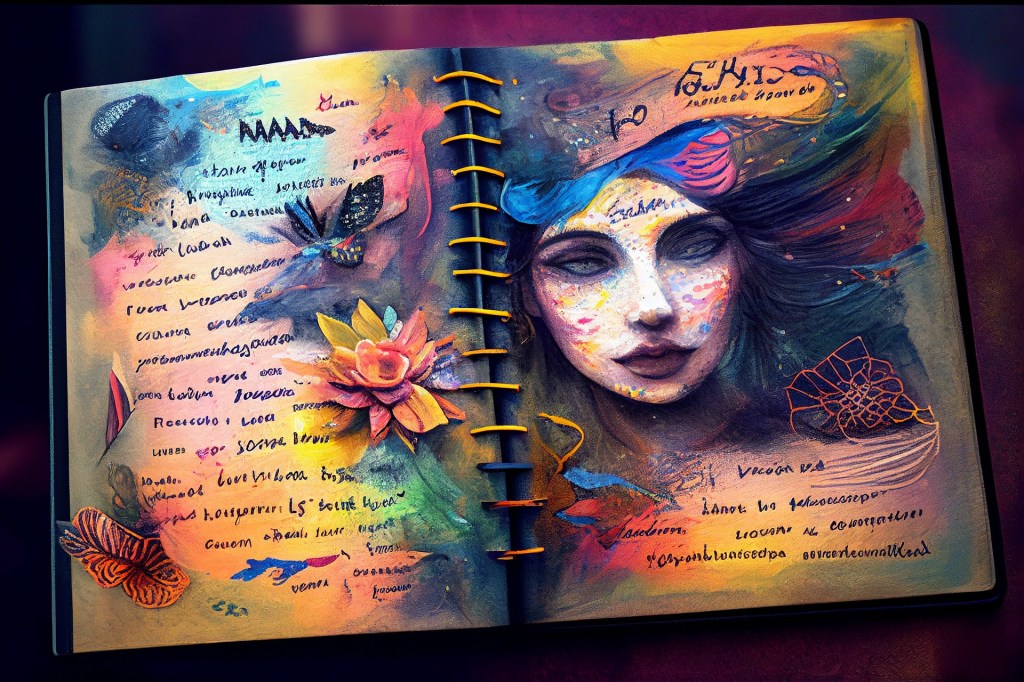
Along the same line, with a greater focus on visual rather than descriptive, is the art journal. Journaling is proven to aid in physical healing. Art is proven to aid in physical healing. So some genius once asked, “Why not blend the two and create something that is doubly healing?” An art journal is a compilation of art that expresses your moods, thoughts, experiences, and much more in visual form. While words are welcome to be included, the art does not necessarily have to contain words in order to count as an art journal, per se. An old adage says, “A picture is worth a thousand words” and this has been passed down by generations of people who believe it to be true. Sometimes pictures tell us more than a story ever could. Sometimes, words fall short. Sometimes, words are too small. Sometimes, we don’t need to be told how to feel. Sometimes we can simply see things that evoke powerful emotions inside us, and we are reminded of a moment that connects us to ourselves and each other in ways that words never could. This is the essence and purpose of art journals: To communicate what words can’t.
There are other ways to journal, to process, and to record your life experiences, but I will end here because I want to ask you:
What is your favorite way to journal?
 Wisdom from the Trenches
Leave a comment