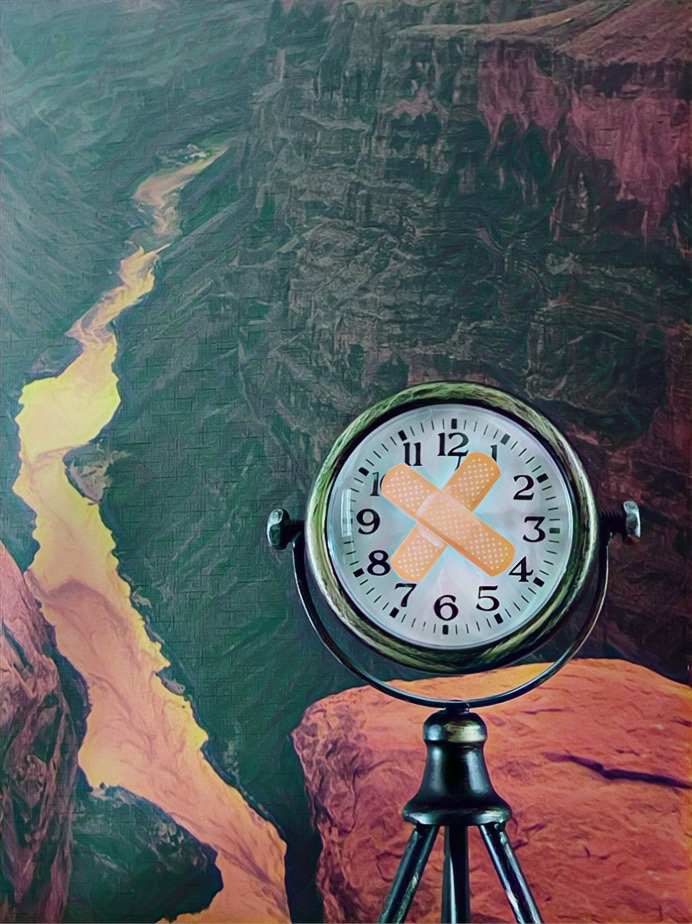
After a particularly good counseling session at the beginning of my trauma therapy, my therapist stopped me at the door to speak some truth to me. I felt like I had unpacked a huge load of shame and felt free in ways I had never previously felt! This new level of healing was so relieving to me personally that I felt almost entirely HEALED. So her words confused me. She told me that most people begin the work, but stop before they reach the end. They don’t know it, but they are left with an open and unhealed wound and a newfound awareness about that wound, but not enough healthy coping tools to help themselves continue the journey alone. They stumble along, wounded and alone, aware of what is wrong but lacking the ability to fully heal. Then she told me not to start the race and then stop before the finish line. In counseling, I should run the whole race and finish strong.
For a time, I thought her words were simply a desperate attempt at job security. Counselors need patients if they want to get paid, right? But I kept going every other week, until a new issue surfaced and triggered a bigger response in me than was warranted for the occasion and the realization hit me that perhaps I am not as healed as I thought. I had mistaken momentary relief for something total and permanent. And then, the reality of my situation sunk in: I had been emotionally unwell for so long that I didn’t even know what “healthy” was anymore! It was unrealistic to expect four years of trauma that I had buried and actively ignored for ten additional years to fully heal in weeks or even months. The passage of time had not healed my wound. I would need to work on healing over time for my hurt to heal. I committed to the entire journey that day and I continued counseling on a weekly basis for three full years.
But, that also wasn’t the only time I went to counseling. Someone once said, “The more you learn, the more aware you are of how little you know.” The further I went into the healing process, the more I realized the depth of my need for ongoing help in my life – and also began to understand that everyone on Earth needs help, healing, and hope in their own lives as well, whether or not they are aware of this need.
If I’ve said it once, I’ve said it a million times: mental health is medical health. I would never only go to my doctor when I have a crisis or emergency, but not make appointments for routine preventative care! That would be foolish. In a world so profoundly messed up in so many ways, no one can possibly make it through life unscathed. We encounter things on a daily basis that damage the state of our mental health in a variety of ways. So, periodically, I check myself back into counseling for a mental health check up, for some fine-tuning, for some validation of more recent experiences, and as a reminder of healthy coping mechanisms.
Over the years, I’ve begun to see my mental health and wellbeing as more of a journey and less of a destination. It’s not a box to check…it’s one of the many areas in my life that continually teaches me new things about my inner being, my core beliefs, and my behavior. And for that, I am grateful. Yes, I am grateful even for the broken parts of me because they teach me new ways to improve my life, my relationship with others, and, most importantly, my relationship with God. I don’t want any part of me to become stagnant, so struggle, insight, discomfort, and life lessons are super important to my growth as a person. And pain, though unbearable at times, has certainly provided those things on an ongoing basis during my life.
However, it is not necessary for me to wallow in pain to grow as a person and, though it is a never-ending process, healing can be evident in a person’s life over the course of time. Here are some changes in me that I saw that have reaffirmed that I was on the right path and headed in the right direction:
- I began to take full responsibility for my present life circumstances and choices. In the beginning of counseling, I used to show up and complain about people who I thought were creating chaos in my life. I began to see that I was creating a distraction to avoid dealing with the real issue. My counselor patiently listened to me gripe until I was ready to deal with the one person I could do something about: me. I knew I had fully accepted responsibility for my life when I entered the therapist’s room and she asked how things were with this or that person and I responded, “You know? It really doesn’t matter. I need to fix me.” No more distractions. No more dramatic displays. No more griping and complaining. I stopped looking around for the adults responsible for my pain and I realized that, unfair as it might seem, I am the adult responsible for healing from the pain.
- I began to feel my feelings – and it was more than just anger. For over a decade after my trauma, I don’t remember crying. Even when deeply hurtful situations surfaced in my life, I did not shed a tear. But I often remember raging. I struggled greatly with anger, especially when I felt threatened. And I still do, at times. I knew I was beginning to heal when my emotions thawed…and I cried. I messy cried for hours. I finally felt grief. I felt sadness. I felt shame. I felt disgust. I felt unimaginable pain. I felt fear. I felt worry. I don’t know if you understand that it didn’t matter what I felt. It mattered that I could feel emotion once again.
- I became more aware of myself, noticing how I felt throughout the day. This helped me better control how I responded. Over time in therapy, I began to develop new skills that I either had not previously possessed or that had remained dormant for a very long time. Self awareness was one skill that I had to work hard to obtain after I had spent years ignoring my gut instincts, mentally blocking events that had happened to me, and actively avoiding reality. I began to notice and acknowledge sensations in my body, and I became able to connect those sensations to emotions that I am feeling. For instance, when my shoulders tense up, I know I’m stressed. When I feel like I’m being choked, I know I’m anxious. I learned how to pinpoint where in my body I felt discomfort, identify what emotions were present that might have contributed to the issue or were a result of the issue, and I was better able to communicate to my husband or my kids how I was feeling…rather than reflexively snapping at them for any irritation that would send me over the edge.
- I became less likely to judge other humans harshly as definitively right or wrong, good or evil…but began to see them in a more accurate and complex light as created by God with the free will to choose how they live. As far as I can see, this is one that most members of the Church struggle with at various times in their lives, but especially hurting members in the Church. When I was stuck in my pain, I saw everything in the world as either all good or all bad. I clung to how right I was to justify my innocence as the victim of a crime that had wounded my body and my soul. I drew a line and I was on the good side. Everyone who wronged me was on the entirely bad side. There was no middle ground. In my pain, I lacked the ability to see that we all make good and bad decisions. It did NOT mean that what happened to me was my fault or insinuate that I was somehow to blame by acknowledging that I also make poor choices at times. By viewing the world through this strict lens of all good or all bad, I wasn’t able to see my own poor choices unrelated to trauma or as a result of trauma, so I wasn’t able to talk to God about those parts of my life and, in so doing, I was forgiven very little so I didn’t live a life characterized by great love for God or for others.
- Traumatic experiences in the past felt like they happened back when they happened and not yesterday. My first counselor told me that victims often bury memory of trauma while the memory is still fresh and very much alive. It comes as a surprise whenever the trauma victim ventures too close to the proverbial trauma gravesite and an arm pops up out of the ground, grabs hold of the victim, and shakes them. What the victim thought was dead can still scare the living daylights out of the victim. She told me that healing requires that we uncover the memories, grieve our losses, and then properly lay the memories to rest – forever. Healing for me was when old memories began to function as old memories, not anything like new ones. The memory was able to pass from the forefront of my mind to the storehouses of long-term memory and I was free to grieve and move on with life without fear that it would pop back to life and jump scare me once again.
- I was able to articulate my emotions and needs to others directly in an assertive manner. For the longest time, I wasn’t even aware that I was expecting others to pick up on how I felt based on how I behaved, by picking up on subtle clues, or by assaulting them with verbal attacks over perceived or actual failings. I never just stated my feelings and asked someone to meet a need. This is actually not healthy behavior as a regular practice. Instead of saying “I’m fine” when I am clearly not fine, assertive communication states directly, “I’m still upset over what happened yesterday evening. When you said XYZ, it really hurt my feelings.” Instead of grumbling at my husband, “You never spend any time with me anymore,” I learned to say, “It’s been awhile since we’ve had a date. When can we go out together this week?” I knew I was healing when I could identify my needs and instead of hiding or disguising those needs, I could ask for others to meet those needs in a clear, direct, and healthy way.
- When others would push my buttons in the same way that used to work in the past, I reacted less often and got better at responding. When pushed beyond my initial tolerance of unhealthy behavior, I have sometimes fallen back into old patterns and reacted poorly to situations. When someone is lying about you or accusing you of things you simply did not do, who wouldn’t attempt to defend themselves? And if you aren’t feeling heard, who wouldn’t become upset? But I have encountered many, many situations that were unkind, triggering, or difficult and I took time to breathe and form a healthy response. Those responses probably blindsided people who knew me well, people who might have been mentally bracing for a certain reaction from me that simply didn’t come. The biggest issue I encountered with the change in how I responded was that healthier people accepted it immediately…but unhealthy people who had acclimated to me being a certain way were obviously upset and would go to even greater lengths in attempts to trigger me and solicit a “normal” reaction from me. This is a common reaction to someone who does the work and begins to change. When I stopped supplying unhealthy people with the drama and chaos they expected from me, they had no choice but to face the reality of their situation and who they are as a person.
- When I was hurt, I stopped to ask for clarification instead of assuming ill intent and becoming immediately offended. When I was stuck in a victim mindset, I behaved as if no one could be trusted, everyone was out to get me, and I took almost everything personally – even if what was said wasn’t directed at me even in the slightest. My therapist first began to challenge this perception of the world and, as I took time to truly analyze the context of situations when things said hurt my feelings, I began to wonder if perhaps I was being a bit too hasty in taking offense. The times that I paused long enough to ask for clarification, I found that most of what people say is said without forethought about the ever so slight possibility that it might be taken in a different way than they intend. So many people think out loud and, as they process through an event or a situation, they often impulsively say things they don’t fully believe themselves. If given the chance to explain, most will choose to rephrase or clarify. That extra moment taken to understand what someone is actually saying has saved me so much unnecessary offense.
- I stopped defining myself by what happened to me and began seeing it as one part of me. Dear reader, this probably looks a little hypocritical of a point because you are reading this on a blog where I have self-identify as a survivor of assault and talk frequently about what that means in my life and how to thrive despite the horrors of trauma. However, only a small portion of my life is focused on this blog. I write posts only every so often. The rest of my time is spent living. Last year alone, I finished writing a book, hiked, camped, homeschooled my kids, sang in an opera, traveled around the US, built a miniature coffee shop, finished folding a thousand origami cranes, colored, revamped my diet, read over thirty books (one of which was the Bible, as I frequently do), and volunteered for numerous organizations, among other things. My life is more than what I say in a thousand-word blog post every so often. Though I talk about mental health often and though I am passionate about healing from trauma, this is only a part of me. I am more than what one person did to shatter me. This perspective shift from hyperfocused on past trauma to broadening my view so it includes all of my life has given me a much more balanced view on life in general and has itself aided in my healing journey because I am no longer fixated solely on pain. I can once again see beauty around me and it is uplifting to my spirit.
- My therapist broke up with me. The day finally came and I was not prepared for it: I had spent an entire hour talking to my counselor about how things were going. Life wasn’t fantastic, but I was meeting life’s challenges in healthier ways! I was actively using the healthy coping mechanisms I had been taught. I understood what was my responsibility and what was not. I felt empowered and at peace. When the time came to get the next appointment on the books, my counselor paused. “I don’t think we need to meet as often as we have been meeting. How do you feel about calling me if you need to talk to someone again and then we can schedule something at that time?” I had finished the race! The person standing at the finish line told me I was done. Anxiety over the unknown gripped me. I panicked. “Are you breaking up with me?!?” I blurted out. My therapist laughed, “Well…yes. Laura, you’re in a good place right now. You’re doing well. I don’t think it’s necessary to keep meeting weekly.” I would go on to hear nearly the same words from two other counselors I went to for entirely different reasons in the span of about nine years. When I lamented the fact that my therapists keep breaking up with me to one of my friends (who is herself a licensed counselor), my friend said, “That’s what a good counselor is supposed to do. They are supposed to help you get to a place where you can deal with life’s problems without their help.” Apparently, all good things do come to an end… I didn’t like hearing that. These counselors all meant so much to me for helping me through challenging situations. I had shared my deepest memories, my darkest emotions, and my most bizarre thoughts with this person. Losing them felt like losing close friends. I always initially felt a little lost. But in time, I saw that I could stand alone and walk on my own two feet – and then I noticed that I wasn’t truly lost because they had pointed me down the right path once again.
I am not perfect at all of these things, but they are changes I have noticed in increasing measure happening in my life over time. Time did not heal my wounds, but doing the hard work under the guidance and supervision of a licensed mental health professional over time helped me unpack unhealthy coping mechanisms and taught me to replace them with healthier ways of perceiving the world, thinking through situations that arise, relating to others, and viewing life. The changes in my life that I have seen over time are a testament to the fact that I am on the right path, and the tools I’ve gained in therapy have helped me journey farther and faster than I would have been able to on my own, bringing me closer to the Lord and to the ultimate and complete healing that I seek.
 Wisdom from the Trenches
Leave a comment