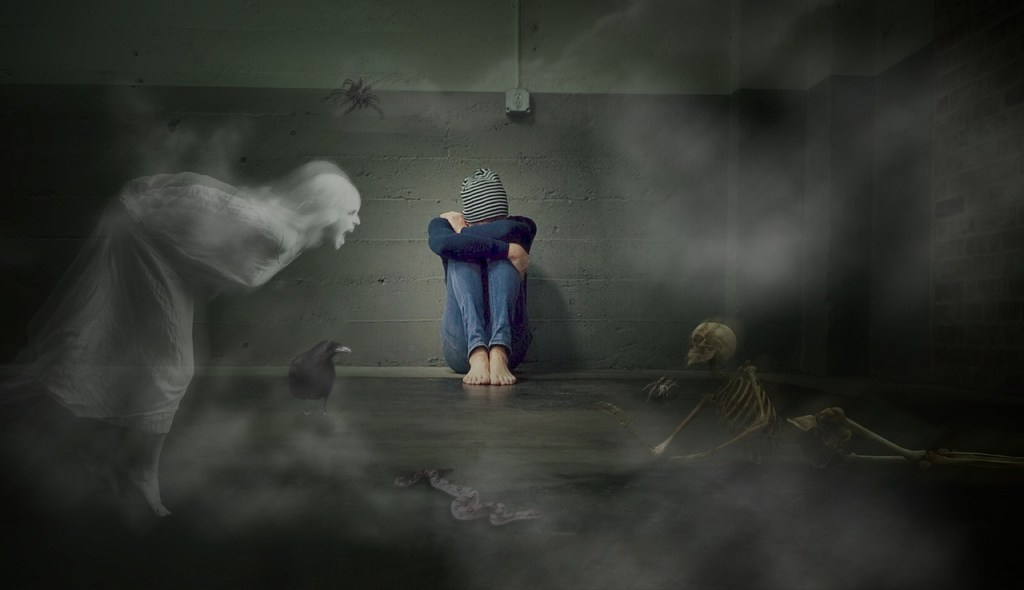
Let’s get something out of the way right up front: panic isn’t the same as fear. I have been afraid. I live with anxiety. People who equate the two usually draw the comparison because they do not actually understand what a panic attack is. Their ignorance attempts to make panic attacks more palatable, to make the attacks sound more manageable/controllable, or worse…to throw scriptures about fear at victims, further shaming them about an invisible injury they didn’t invite into their lives and cannot erase. Panic is NOT fear…panic is uncontrollable horror that emerges when the body involuntarily remembers a particularly traumatic event. Drawing a parallel between the two is the same as drawing a parallel between feeling sad about a rough work day and grieving the tragic death of your young child. Sadness and grief are NOT on the same playing field. Fear and panic are NOT on the same level. They are as different as preschoolers playing T-Ball in the park and professionals playing competitive baseball in the World Series at Fenway.
Oftentimes, it is something trivial or inconsequential that triggers an attack – a word, a smell, a memory. Usually, it isn’t traceable, making it difficult to logic my way out of the panic attack or even prepare for the next one. But something triggers me and in an instant, I am brought back to my worst memory, facing life-threatening absolute hell most people cannot even imagine. I am physically present, but emotionally responding to a literal nightmare. My brain’s last message to my body is that I am, right in this moment, in very real danger. My breathing becomes rapid and shallow. I feel like I can’t get enough oxygen. I can feel my heart pick up speed and begin randomly skipping beats. After it skips a beat, I get a head rush – like the feeling you get when a rollercoaster plummets down after that first hill. No. Like the feeling you get when your AIRPLANE suddenly plummets several miles straight down. It’s an adrenaline rush that comes with every glitch in my heartbeat – and it is never fun. It shorts out my brain every time. As I scramble to ground myself and begin the frantic task of bringing myself back into reality, my brain periodically buzzes and shuts off. Think, think, think…FRIED. Think, think…FRIED. Fear rises up because I am losing control of my body and mind. I am basically drowning, but there isn’t any sign of water. My fingers and toes go numb. My legs and arms begin to feel weird. My lips turn purple during really bad panic attacks. I feel sick. I think I’m having a heart attack. The ability for rational thought feels just out of reach. My muscles tense as if fighting or fleeing might be necessary in any moment. I get a pounding headache. My ears begin to ring and increase in volume until the ringing is deafening. I can’t see straight and my vision is blurry. I might scream at anything that moves around me because I can’t tell whether it is a threat or not and I am terrified. I am essentially sucked up by a tornado, battered by debris, surrounded by deafening chaos, grasping desperately at anything around me in an attempt to stop spinning out of control, in the hope that I can feel or see something that might make sense again. But it is futile. And I am frightened. What is going on? Why am I here? How do I make it stop? Will I ever be able to get back to where I once was? But I can’t answer those questions because I am assaulted on all sides by fragments of dark memories that begin to drag me under. I fight as long and as hard as I can just to stay present and to breathe. I flail wildly about and I fail to stop the descent into madness. As suddenly as the panic attack started, it ends. I am left exhausted to the core, cheeks streaked with tears, head pounding and void of thought. I crawl into bed and sleep for hours. For days following the panic attack, I struggle with deep depression. I dream confusing and creepy dreams. Sleep is a necessary evil. I need it. I don’t want it. I become paranoid that another panic attack will hit me out of the blue and I don’t like going places alone. Or at all.
Welcome to my life. Lather. Rinse. Repeat.
Telling someone who deals with panic attacks that they should not fear is about as helpful as telling someone with Alzheimer’s or dementia that writing little notes will eliminate the forgetfulness. Band-Aids don’t work on hemorrhaging wounds. Small solutions don’t work in complicated conditions. But I have learned over time that small steps, taken one right after the other, can move me off a battlefield and into safety. That is why it’s important to have a plan for when worst case scenario strikes. No, rational thought won’t always be available…but sometimes, it will. And when it is, it’s best to be prepared. With God’s help, I have found a few things that work for me. I want to emphasize for me because the same things do not work for different people.
1. I have learned to recognize the signs and symptoms of panic. Is my breathing speeding up? Does my left arm feel like I might be having a heart attack? Whatever it is, something in my body always tips me off to the fact that, internally, my body is beginning to shift. No, I don’t always pick up on it early enough…but at some point, I do pick up on it. Which helps me…
2. Ground myself. Exit any potentially complicating situations (like, pull to the side of the road and park the car). Find somewhere safe to sit, so that I don’t fall and injure myself. Grab something familiar – a teddy bear, pet my dog, hold a rock, hug a throw pillow – anything that is from present day. Touching something is incredibly powerful in keeping me present. So is sound…
3. So I begin talking to myself. Out loud. “This is a rock. It’s shaped like a heart. You found it on a trail. Do you remember the trail? Think about the trail. You aren’t having a heart attack. You are having a panic attack. You’re in a grocery store. It’s 2022. You’re here to buy tortillas.” Does it sound dumb? Yes, yes it does. Does it help me focus on present day and not my wildly out-of-control symptoms? Yes, yes it does. Speaking the mundane reality of life to myself quiets the horrors of memories long past. I also talk to God. Ok, in all honesty, if I’m really struggling, I cry out for Jesus repeatedly. But I have learned that words aren’t even necessary when I am in distress, that God is near to those who are hurting, and that He has always been faithful to walk with me through trying times.
4. Rest. Panic attacks are exhausting. Afterward, my head hurts, I am irritable, I am dehydrated, and my vision is blurry. If I can, I crawl in bed and sleep. When my children were young, I would put on a movie and sleep on the couch next to them. When I worked full-time, I would set an alarm and relax in my car with quiet music on.
5. Seek professional help. Counseling has made the biggest difference in my life by helping me become more aware of my body and my issues, equipping me with healthy coping mechanisms to deal with my challenges, and granting me the wisdom to accept what I cannot change and the courage to do what I can every day of my life as I move forward.
And I do move forward. It is one of the most courageous things a survivor will ever do.
 Wisdom from the Trenches
Leave a comment